
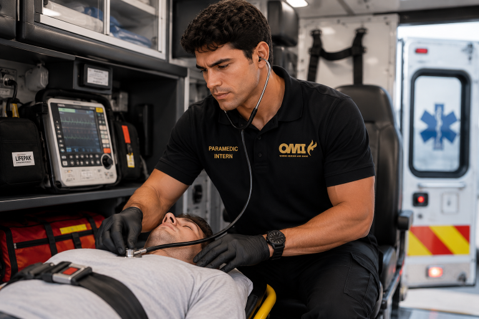
Many people interested in becoming an Emergency Medical Technician wonder what their daily work schedule will look like. Unlike traditional office jobs, EMTs often work flexible and rotating shifts because emergency medical services operate twenty-four hours a day. Understanding EMT shift schedules can help prospective students decide if this fast-paced healthcare career is the right fit for their lifestyle.
If you are considering EMT training, learning how EMT work schedules operate is an important step in understanding the profession and preparing for your future career.

Why EMTs Work Nontraditional Schedules
Emergency medical services must be available at all times to respond to accidents, medical emergencies, and disasters. Because of this constant demand, EMTs work rotating shifts that ensure emergency response teams are always ready.
This type of scheduling allows emergency medical services organizations to maintain full coverage throughout the day and night. It also means EMTs often work fewer days per week but with longer shifts compared to many traditional careers.
For many professionals, these schedules offer a unique balance between work and personal time.
Common EMT Shift Schedules
Although schedules may vary depending on the employer, several common shift patterns are widely used in emergency medical services.
12 Hour Shifts
One of the most common EMT schedules is the twelve hour shift. In this model, EMTs typically work either a day shift or a night shift.
A typical schedule might look like this:
Three to four twelve hour shifts per week
Day shift from approximately 7 AM to 7 PM
Night shift from approximately 7 PM to 7 AM
This schedule often provides several days off each week, which many EMTs appreciate for rest or personal activities.
24 Hour Shifts
Some ambulance services and fire departments operate on twenty four hour shifts. In this model, EMTs remain on duty for a full day and night before receiving extended time off.
A typical rotation might include:
Twenty four hours on duty
Forty eight hours off duty
During slower periods, EMTs may rest while remaining available to respond to emergencies.
Rotating Shifts
Some EMS organizations use rotating schedules where EMTs alternate between different shift times. This can include switching between day shifts, night shifts, or weekend coverage.
While rotating shifts require flexibility, they allow agencies to distribute coverage evenly among staff members.
Part Time or Per Diem Shifts
Many EMTs also work part time or per diem shifts. This option allows individuals to work a flexible number of hours based on availability.
Part time EMT roles are common for students, healthcare workers seeking additional experience, or individuals exploring the field before committing to full time employment.
What a Typical EMT Work Week Looks Like
Although every EMS agency operates differently, a typical EMT work week often includes a combination of patient calls, equipment checks, and station responsibilities.
During a shift, EMTs may:
Respond to emergency calls through dispatch
Provide patient assessment and emergency care
Transport patients to hospitals or medical facilities
Complete medical documentation and reports
Restock and prepare medical equipment for the next call
Some shifts may be extremely busy with multiple calls, while others may allow downtime at the station. The unpredictable nature of emergency medical services is one of the aspects that many EMTs find both challenging and rewarding.
Advantages of EMT Work Schedules
While EMT schedules are different from traditional work hours, many professionals appreciate the flexibility they provide.
Some advantages include:
Fewer workdays per week
Extended time off between shifts
Opportunities for overtime
Flexible part-time scheduling options
These scheduling patterns allow EMTs to pursue further education, family time, or other professional opportunities.
Preparing for an EMT Career
Understanding EMT shift schedules is just one part of preparing for a career in emergency medical services. Prospective students must also complete formal EMT training that teaches them how to respond effectively in emergency situations.
EMT programs provide the knowledge and practical skills needed to assess patients, perform life-saving interventions, and safely transport individuals to medical facilities.
Graduates of EMT programs typically pursue certification as a Nationally Registered EMT and may apply for state certification depending on their location.
EMT Training at Orlando Medical Institute
For students interested in beginning an EMT career in Orlando, Orlando Medical Institute offers a comprehensive Emergency Medical Technician training program designed to prepare students for certification and real-world emergency care.
Upon successful completion of the program, graduates are eligible to take examinations for certification as a Florida State Emergency Medical Technician and a Nationally Registered EMT.
The program provides an engaging educational experience led by experienced and highly qualified instructors who are dedicated to helping students succeed in the field of emergency medical services.
Students receive training through a variety of learning methods, including:
Classroom instruction covering emergency medical principles
Hands-on laboratory exercises using professional medical equipment
High-fidelity simulation training that replicates real emergency scenarios
Clinical rotations in healthcare settings
Real-world field experience
This comprehensive training model helps students develop both theoretical knowledge and practical skills required for emergency medical care.
A Modern Flipped Classroom Learning Model
A distinctive feature of the EMT program at Orlando Medical Institute is its use of the flipped classroom learning model. In this approach, students review foundational material through guided learning modules outside the classroom.
Classroom time is then focused on interactive activities, discussions, and practical applications that reinforce the material. This method encourages greater student engagement and allows instructors to provide personalized feedback and support.
Research across many academic disciplines shows that flipped classroom models can significantly improve student learning outcomes.
EMT Program Requirements
Students interested in enrolling in the EMT program must meet several basic admission requirements.
Applicants must:
Be at least 18 years of age or older
Possess a high school diploma or GED
Provide a valid Social Security card
Present a valid driver’s license or government-issued photo ID
Complete the admissions assessment known as the DAX
After enrollment, students must also complete clinical compliance requirements before participating in clinical rotations. These requirements include health documentation, immunization records, background screening, and other medical clearances.
Flexible EMT Training Schedules
Orlando Medical Institute offers multiple schedule options to help students balance training with other responsibilities.
Schedule Type I
Monday, Wednesday, Thursday
9:00 AM to 1:00 PM
Schedule Type II
Monday, Wednesday, Thursday
6:00 PM to 10:00 PM
Schedule Type III
Friday 6:00 PM to 10:00 PM
Saturday 9:00 AM to 6:00 PM
These flexible schedules make it possible for many students to pursue EMT education while managing work or family commitments.
EMT Training Course Breakdown
The EMT training program includes a structured combination of classroom instruction and hands-on experience designed to prepare students for certification and professional practice.
176 hours of classroom instruction
52 hours of laboratory training
72 hours of hands on learning
300 total training hours
This balanced structure ensures students receive both the theoretical knowledge and the practical skills necessary for a successful career in emergency medical services.
Start Your EMT Career in Orlando
Understanding EMT shift schedules helps prospective students see what life in emergency medical services looks like and how flexible scheduling can fit different lifestyles. With the right training and preparation, individuals can begin a rewarding career helping patients during critical moments.
Take the first step toward becoming a certified Emergency Medical Technician by enrolling in the EMT training program at Orlando Medical Institute and begin building your career in emergency medical services in Orlando, Florida.
